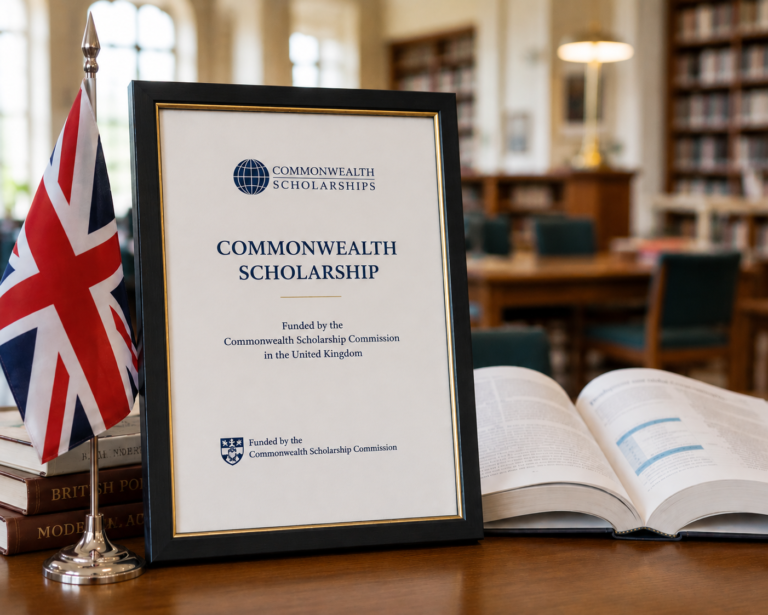
If you are a Nigerian student with a strong academic record and a clear vision for your future, the Commonwealth Masters Scholarship is one of the most direct routes to a fully funded UK degree. Backed by the UK government and awarded to citizens of developing Commonwealth countries, this scholarship covers everything from tuition to flights to monthly living costs — with no loan or repayment attached. Nigeria is on the eligible countries list, and every year Nigerian students win this award and go on to study at top UK universities. This guide tells you exactly who qualifies, what you receive, and how to apply.
The Commonwealth Masters Scholarship is administered by the Commonwealth Scholarship Commission (CSC) in the United Kingdom and funded by the UK Foreign, Commonwealth and Development Office (FCDO). It is designed specifically for candidates from developing Commonwealth nations who are committed to returning home after graduation and contributing to their country’s development. The scholarship is not a pathway to UK residency — the Commission takes the return commitment seriously, and your application must reflect a genuine plan to bring your new skills back to Nigeria.
Who Can Apply — Eligibility Requirements
To qualify for the Commonwealth Masters Scholarship as a Nigerian applicant, you must meet all of the following conditions:
- You are a Nigerian citizen and are permanently resident in Nigeria at the time of applying
- You hold a first degree with at least Second Class Upper Division (2:1) — this is a firm academic requirement for the Masters route
- You have not previously studied in the UK on a Commonwealth Scholarship
- You are committed to returning to Nigeria after completing your studies
- You can clearly demonstrate how your proposed course of study connects to Nigeria’s development needs
- You hold an NYSC discharge or exemption certificate
- Your intended course is not an MBA — MBA programmes are excluded from this scholarship
If you hold a 2:2 degree, the Masters route is not available to you, but you may still qualify for the Commonwealth PhD Scholarship, which accepts a lower second-class degree from applicants with relevant professional experience.
What the Scholarship Covers
The Commonwealth Masters Scholarship is fully funded. Successful Nigerian scholars receive the following:
- Full tuition fees paid directly to your UK university — you are not liable for any portion of the cost
- A monthly living allowance to cover accommodation and daily expenses — for the 2025–2026 academic year this was approximately £1,452 per month, rising to around £1,781 per month for scholars at universities in the London area
- Economy-class return airfare between Nigeria and the UK
- A warm clothing allowance upon arrival in the UK
- A study travel grant for fieldwork or research-related travel where applicable
- No bond, no loan, no repayment — the award is an outright grant
How to Apply — Step by Step
Step 1: Confirm your eligibility. Check every requirement above against your qualifications and current situation before you begin. If your degree is below a 2:1, do not apply for the Masters route — explore the PhD route instead.
Step 2: Identify your nominating body. Nigerian applicants cannot apply directly to the Commonwealth Scholarship Commission. You must apply through an approved national nominating agency. The primary route in Nigeria is through the Federal Scholarship Board (FSB) under the Federal Ministry of Education. Some approved universities and NGOs are also permitted to nominate candidates. Check the FSB website and the Ministry of Education portal for the current cycle’s instructions.
Step 3: Prepare your documents early. You will need your undergraduate degree certificate and transcripts, your NYSC certificate, two or more strong reference letters, a personal statement that clearly explains how your proposed study relates to Nigeria’s development, and evidence of any relevant work experience. Incomplete applications are rejected without review, so prepare everything well in advance.
Step 4: Submit through your nominating body before their internal deadline. Each nominating body runs its own selection process and sets its own internal closing date, which is always earlier than the Commission’s own deadline. Do not wait for the Commission’s deadline — contact the FSB early and submit as soon as their portal opens.
Step 5: Await shortlisting and Commission review. If your nominating body selects you, your application is forwarded to the Commonwealth Scholarship Commission in the UK for final review. The Commission makes the final award decisions independently.
Step 6: Secure your UK university offers. Shortlisted applicants are typically required to obtain at least two offers of admission from UK universities that are partnered with the Commission. Begin researching eligible universities and preparing your university applications alongside your scholarship application — do not wait until after you are shortlisted.
Deadline Information
Applications for the Commonwealth Masters Scholarship typically open in September and close in November each year, with studies beginning in the UK the following September or October. The 2026–2027 cycle has now closed. The 2027–2028 application cycle is expected to open in August 2026. Nigerian applicants should monitor the Federal Scholarship Board website and the Commonwealth Scholarship Commission website for the exact opening date and any updates to the nomination process.
Moreschooling will publish an update as soon as the next cycle opens. Bookmark this page and check back regularly so you do not miss the window.